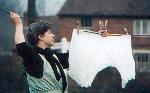
In the nineteenth century working-class town and village families often used communal washhouses, with each housewife having to do her washing on a specific day. After the 1870's it became more common to incorporate individual washhouses and privies at the rear of 'tunnel back' houses. The washhouse or scullery was usually known locally as the brewhouse as it was often the scene of home brewing operations. The name is pronounced differently in various areas. Old Hill people, for example, call it the 'brewus', whilst in Tipton it is the 'bruce'. Around the Museum site we have many examples of the Black Country 'brewus', which children can look at and see the following: kitchen range and side oven; copper; various washing implements; shallow sink made of glazed stoneware; tin bath and pump. Pumps were used to draw water from a cistern under the brewhouse floor, which was filled by means of rainwater pipes.
The wash was often prepared by soaking over night or longer in lye (alkaline liquid obtained from wood ash) or cold water with soda. Soap was often home made, consisting of fat (e.g. kitchen grease), alkali and common salt. Water was heated in a wash boiler or copper by means of a coal fire underneath. Hot water from the boiler was ladled into the washing bowl or tub where it was dollied. A number of objects were used for dollying. The dolly peg was used to rotate the clothes, it looks like a small four-legged stool with a handle some three feet long fixed upright from the centre of the stool's 'seat'. The wash punch was used with a straighter up-and-down action than the dolly peg and has a small barrel-like cylinder instead of a stool. A posher/posser, usually a perforated copper cone on a long handle, agitated the clothes with a vigorous up and down movement.
After dollying, the wash was transferred into another tub for hand rubbing sometimes using a corrugated wash board. From here, the wash was transferred into the copper and boiled. When ready the clothes were lifted out with a straight 'dolly stick' and rinsed in tubs. Usually three rinsing waters were used, the first warm, the second much cooler and the third a blued water. Items of clothing to be starched, were laundered and wrung out, then steeped for several minutes in a hot solution of starch until well soaked. Colars and cuffs often received this treatment.
Once the clothes had been washed and rinsed, the excess water had to be squeezed out. For this process a mangle was usually deployed. The wet wash was fed between rollers which were cranked round by hand. Washing was often dried outside, fixed to a line with gypsy pegs. However, if there was too much dirt in the air from factories or it was raining, washing had to be dried indoors in front of the fire.
In the nineteenth century, the sad (i.e. solid) or flat iron was often used in pairs, one being heated while the other was in use. The common method of heating them was to prop them face up on a trivet in front of the fire.
| Reference: | 507 |
| Keywords: | Wash Houses Brewus Lye Soda Dolly Clothes Iron BCLM |
| Archive Ref: | Marketing Photograph Collection |
| Updated: | 6/9/2001 11:50:11 |