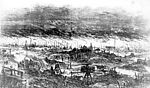
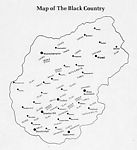
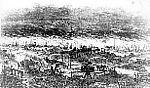
"The Black Country" was named after the smoke and grime of its industries which made it one of the world's great industrial regions on the nineteenth century. The area lies across the old boundaries of South Staffordshire and Worcestershire (now part of the West Midlands), and between the towns of Wolverhampton, Walsall, Halesowen and Stourbridge.
Despite rapid industrial growth, the title "Black Country" was not used for a long time. There are many descriptions of the land laid waste by coalmining, "the earth turned inside out", the "interminable villages interspersed with heaps of pictoral burning", the "black district", before the term first appears as a chapter title in Samuel Sydney's Rides on Railways published in 1851. "In that great coalfield a perpetual twilight reigns during the day, and during the night fires on all sides light up the dark landscape with a fiery glow and for miles on miles a black waste spreads around, where furnaces continually smoke, steam engines thud and hiss, and long chains clank". The Rev. Arthur Mansell in 1857 wrote "your eye wanders over a vast expanse of grimy country unrelieved scarcely by the gleaming of a single blade of grass there is a weird funeral air around the place but at night the horizon wears a glowing belt of fire".
Elihi Burritt, the blacksmith turned American Consul in Birmingham, wrote in 1869, "The Black Country, black by day and red by night, cannot be matched, for vast and varied production, by any space or equal radius on the surface of the globe".
Rollover the captions in the box to see the available images in thumbnail format, click the caption to see the full-size image
| Reference: | 533 |
| Keywords: | Smoke Black Industrial Growth Industry Revolution Environment MCOL BCLM |
| Archive Ref: | Museum Guide Notes and Photograph number 1027 4.212 |
| Updated: | Wed 19 Apr 2006 - 0 |