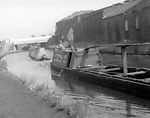
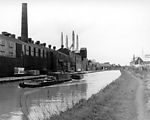
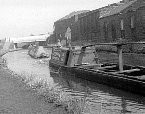
Canals were developed in the late eighteenth and early nineteenth centuries as a cheap way of transporting raw materials, particularly coal, in bulk. It was the canals that enabled the Black Country to develop as a major industrial centre; they were ideal for transporting the iron ore, coal and limestone from the local mines to nearby ironworks.
Canals were also used to transport the finished products from the Black Country to the rest of England and beyond. Much of this long distance traffic was lost with the coming of railways in the mid-nineteenth century, but local canals were still used for carrying over short distances and for taking goods to the railways.
After the First World War motor road transport increased while many of the old Black Country industries disappeared as raw materials dwindled. For these reasons there was a slow decline in canal trade, although commercial canal carrying managed to survive on a small scale right up to the late 1960s.
The canal arm here was built in 1840 to serve the lime kilns; boats would bring the fuel and limestone to be burned and would carry away the quicklime produced. The other canalside industries found nearby would also have made use of the canal arm in a similar way.
Follow the towpath to discover more about Black Country Canals
Rollover the captions in the box to see the available images in thumbnail format, click the caption to see the full-size image
| Reference: | 519 |
| Keywords: | Iron Ore Limestone Coal Raw Materials Commercial Arm Quicklime 1900s 2000c BCLM MCOL |
| Archive Ref: | Oldbury Photo Collection BCM Box 3 |
| Updated: | 17/8/2001 14:07:57 |